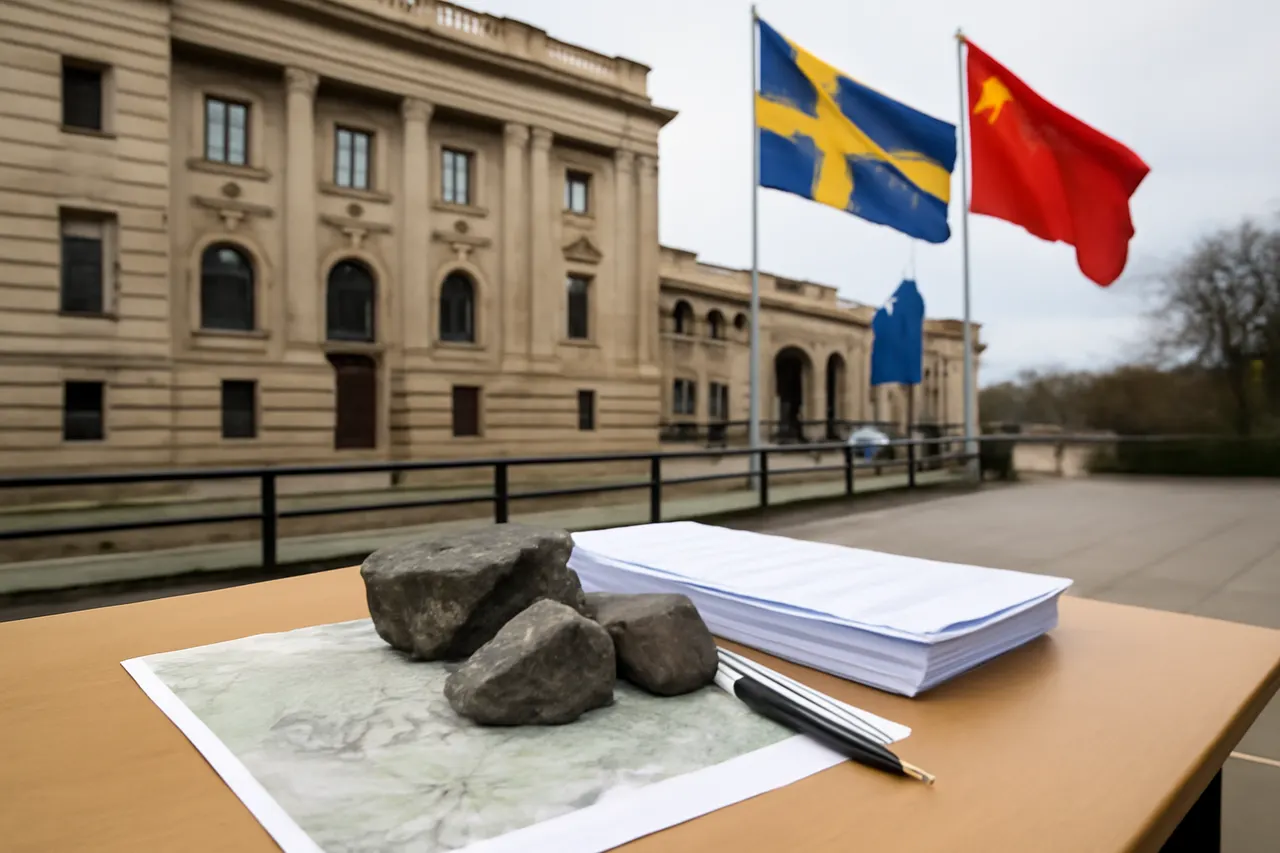
On Thursday, July 23rd, 2026, Sweden announced a new strategy to enhance its mining sector, particularly focusing on rare earth minerals, to reduce Europe's dependence on China. The government in Stockholm declared the mining of critical metals and rare earth minerals a national security interest, aiming to expedite and simplify the permit process for new extraction projects.
Resource-rich Sweden, already home to Europe's largest iron ore mine, has discovered significant rare earth deposits at the Arctic Circle site in Kiruna. These minerals are vital for renewable energy, defense, electric vehicle production, and modern computer manufacturing. Currently, China accounts for about 70% of global mining and refining of these materials.
Energy Minister and Deputy Prime Minister Ebba Busch emphasized that Sweden must become a leading mining nation and outlined plans to streamline authorization procedures to accelerate decision-making. Busch stated, "We believe that this can contribute significantly to both Sweden's, the EU's, and NATO's defense capabilities," describing European industry's dependence on China as a "systemic risk."
The government also intends to facilitate land assignments for mining projects, a move that has raised concerns among the Sami reindeer-herding indigenous people. The Sami warn that expanded mining could threaten their traditional way of life. The mining town of Kiruna has faced challenges in recent years, including relocating homes and buildings due to subsidence caused by mining operations undermining the city.
This initiative reflects Sweden's effort to secure strategic resources domestically and strengthen European supply chains amid geopolitical concerns.
Loading comments.