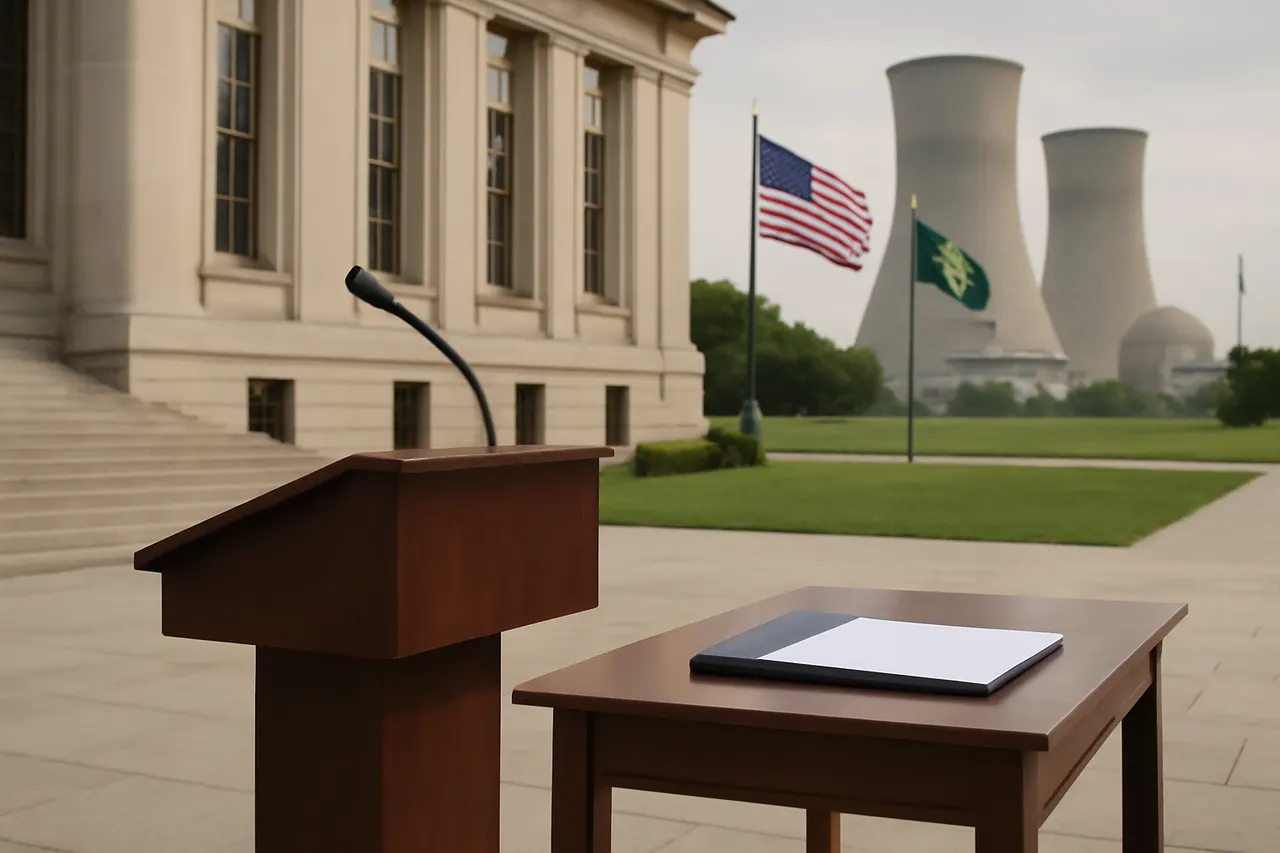
At the end of February 2026, nuclear talks between the US administration and Iran collapsed when Washington withdrew and launched a bombing campaign on Iran alongside Israel's Prime Minister Benjamin Netanyahu. One of the stated reasons for this military action was to stop Iran from enriching nuclear fuel.
On Wednesday, July 23rd, 2026, former US President Donald Trump formally approved a nuclear deal with Saudi Arabia, a close US ally. The agreement, signed by the US Secretary of Energy and Saudi Arabia's Minister of Energy, allows Saudi Arabia to build nuclear reactors using American technology and to enrich uranium.
The US Department of Energy described the agreements as laying "the legal foundation for a decades-long, multi-billion-dollar partnership that advances several priority economic and strategic objectives, including nuclear non-proliferation."
Details of the civil nuclear deal remain undisclosed, but US media reports indicate American companies will play a central role in developing Saudi Arabia's new power reactors and nuclear technology. The deal includes plans to invest approximately $US2.43 billion ($3.46 billion) to build a nuclear manufacturing equipment industrial cluster in Saudi Arabia.
Experts and politicians have expressed concern over the deal's implications. Mona Yacoubian, director and senior adviser of the Middle East Program at the Center for Strategic and International Studies, said, "Clearly this is meant to signal Iran that the US is willing to basically allow its allies and partners in the region and the Gulf side to gain a nuclear capability … should it [Iran] choose to try and seek a nuclear weapons capability."
John Erath, senior policy director at the Center for Arms Control and Non-Proliferation, noted that if the deal is executed properly, it could reinforce non-proliferation standards through transparency and inspections.
However, Democratic Senator Edward Markey criticized the move, stating, "They are allowing Saudi Arabia, a belligerent and authoritarian nation, to develop nuclear weapons technologies while starting a war with Iran under the guise of preventing an Iranian nuclear bomb."
Yacoubian further warned of a darker scenario: "The US in essence acquiescing to the possibility that Iran may indeed pursue a nuclear weapon, or a nuclear weapons capacity, and then we see the beginning of a nuclear arms race in the Middle East, which would be an extraordinarily dangerous development."
The agreement could also strengthen US-Saudi ties and prevent Russia and China from gaining a strategic role in Saudi Arabia's nuclear program. Yet, some analysts caution that if the US cedes the nuclear supply role early, Moscow or Beijing might become the primary stewards of Riyadh's nuclear ambitions.
Loading comments.